



Please fill in the form below !

Rib cartilage rhinoplasty is an aesthetic surgical approach that uses cartilage harvested from your own rib cage to reshape or support the nose. Because the graft is autologous, it avoids foreign-material rejection and may be useful when substantial structural support is needed. This article from EMCAS Aesthetic Hospital explains how rib cartilage rhinoplasty works, who may be considered for the procedure, its potential benefits and limitations, recovery, and the surgical process at EMCAS.
What Is Rib Cartilage Rhinoplasty?
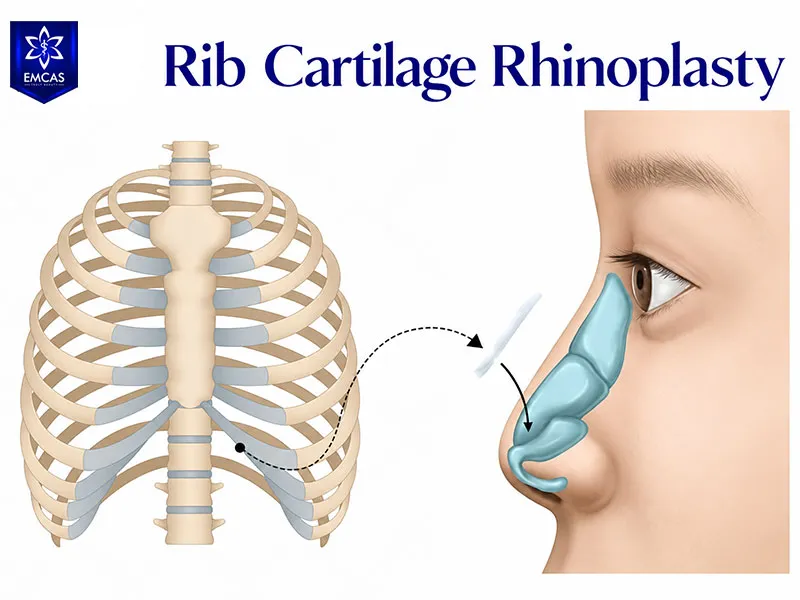
Rib cartilage rhinoplasty is a type of rhinoplasty that uses autologous costal cartilage to reshape and support the nasal framework. Depending on the surgical plan, cartilage may be harvested from the 5th through 9th ribs and shaped to increase bridge projection, reconstruct structural support, or correct specific nasal concerns.
This approach may be considered for people who are not suitable for synthetic nasal implants or who have undergone previous rhinoplasty and require more extensive structural reconstruction. Because the graft comes from the patient's own body, it is generally biocompatible and avoids allergy or rejection related to a foreign implant.
As with any rhinoplasty procedure, suitability and risk depend on nasal anatomy, previous surgery, general health, and the planned technique. An in-person assessment by a qualified surgeon is important before deciding whether rib cartilage is appropriate.
Can Rib Cartilage Resorb After Rhinoplasty?
Rib cartilage is autologous tissue, so it is generally well tolerated and can provide substantial structural graft material. However, this does not mean that the graft is completely free from long-term changes or complications.
After rib cartilage is harvested, the surgeon shapes and places the graft according to the planned nasal reconstruction. The graft is intended to provide structural support and maintain the designed contour as healing progresses.
Graft resorption can occur, although published pooled data have reported relatively low rates. Rib cartilage can also undergo changes such as warping or calcification, and outcomes vary with graft preparation, surgical technique, tissue condition, and individual healing. These considerations should be discussed with the surgeon during preoperative planning.

Who May Be a Candidate for Rib Cartilage Rhinoplasty?
Rib cartilage is not necessary for every rhinoplasty. Suitability should be determined by a surgeon after evaluating the nasal structure, previous procedures, available cartilage, general health, and aesthetic goals. Rib cartilage rhinoplasty may be considered in situations such as:
- People who have undergone multiple previous rhinoplasty procedures and now have structural problems such as deviation, loss of support, implant displacement, or visible redness at the nasal tip.
- People who are not suitable for a synthetic nasal implant or who require an autologous graft as part of the surgical plan.
- Cases with significant nasal damage or insufficient cartilage and soft-tissue support after previous surgery.
- Cases that require a larger amount of graft material or stronger structural support to reconstruct the nasal framework.
Read more: Autologous Cartilage Rhinoplasty: Types, Procedure and Cost
Pros and Cons of Rib Cartilage Rhinoplasty
Rib cartilage can provide a substantial amount of autologous graft material and is often considered when stronger structural support or more extensive reconstruction is required. However, the procedure also involves a chest donor site and has limitations that should be considered before surgery.
Potential advantages of rib cartilage rhinoplasty:
- High biocompatibility: Because rib cartilage comes from your own body, it avoids foreign-material allergy or rejection associated with a synthetic implant.
- Useful for complex reconstruction: Rib cartilage can provide substantial graft volume and structural support for revision cases or noses that require more extensive reconstruction.
- Can be shaped for an individualized contour: The surgeon can carve the cartilage according to the nasal framework and planned bridge or tip support.
- Potential for long-lasting structural support: When appropriately selected, prepared, and placed, autologous rib cartilage can provide stable support over the long term.
Potential limitations of rib cartilage rhinoplasty:
-
Higher cost: Compared with some implant-based rhinoplasty procedures, rib cartilage rhinoplasty may cost more because it requires cartilage harvesting and more complex surgical planning.
-
Longer and more complex surgery: The procedure includes an additional step to harvest cartilage from the chest before the graft is prepared and used in the nose.
-
A chest donor-site scar: Rib cartilage is harvested through a chest incision. The scar may be relatively small and placed discreetly, but its appearance varies with surgical technique and individual healing.
Because rib cartilage rhinoplasty involves both nasal surgery and cartilage harvesting from the chest, the procedure should be planned by a qualified surgeon after an in-person assessment of your anatomy and medical suitability.

How Long Does Rib Cartilage Rhinoplasty Take to Heal?
Swelling and bruising are usually most noticeable during the first one to two weeks after rhinoplasty and gradually improve. The nose may look more settled over approximately 3–6 months, while final refinement can take up to a year or longer, particularly after complex or revision rhinoplasty. Recovery varies between individuals.
Rib cartilage rhinoplasty can provide long-lasting results, but there is no fixed duration that can be guaranteed for every patient. Long-term stability depends on factors such as the surgical technique, graft behavior, nasal anatomy, individual healing, aging, and postoperative care.
Rib Cartilage Rhinoplasty Procedure at EMCAS
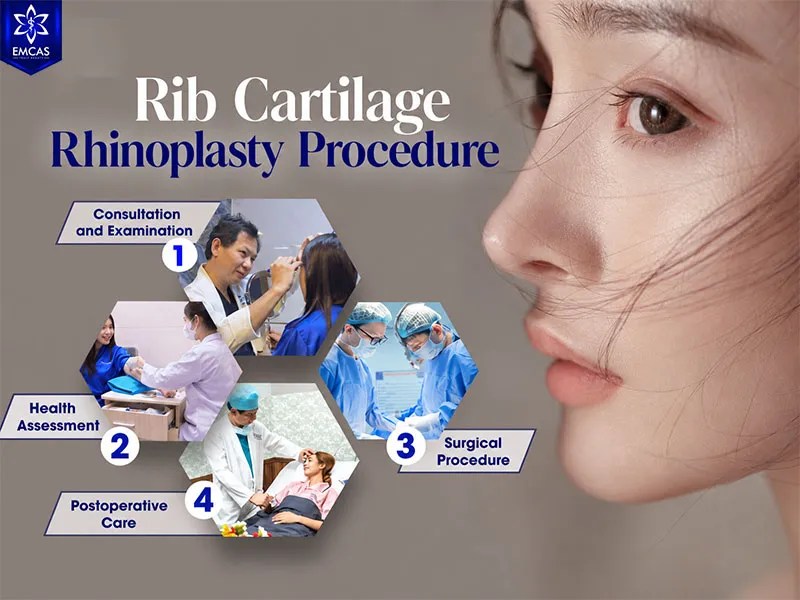
At EMCAS Aesthetic Hospital, rib cartilage rhinoplasty includes consultation, preoperative assessment, surgery, and postoperative monitoring. The exact surgical plan is individualized according to the patient's nasal anatomy, previous procedures, available cartilage, and treatment goals.
Step 1: Consultation and examination
The surgeon examines the current nasal structure and discusses your aesthetic goals. Morpheus 3D imaging may be used to help visualize the proposed nasal shape and support surgical planning.
The surgeon also explains how rib cartilage will be harvested and used, the planned surgical approach, and the nasal design considered appropriate for your anatomy.
Step 2: Preoperative health assessment
Before surgery, preoperative checks may include an anesthesia assessment, blood tests, an electrocardiogram, and other examinations considered necessary by the medical team to determine whether you are medically suitable for surgery.
Step 3: Surgery
The procedure is performed in an operating room under the anesthesia plan selected by the medical team. Through a small incision in the chest, the surgeon harvests the required rib cartilage and then prepares and shapes the graft according to the planned nasal reconstruction.
The surgeon creates the required surgical access to the nose, prepares the graft recipient site, positions the rib cartilage according to the surgical plan, and closes the incisions with sutures.
Step 4: Postoperative monitoring and care
After surgery, you remain at the hospital for postoperative monitoring for the period recommended by the medical team. After discharge, follow the wound-care instructions, take prescribed medication as directed, and attend scheduled follow-up appointments.
EMCAS Aesthetic Hospital operates in Ho Chi Minh City under a Ministry of Health license for medical examination and treatment. You can learn more about the EMCAS medical team, hospital facilities, and available aesthetic surgery services before scheduling a consultation.
In summary, rib cartilage rhinoplasty may be considered when substantial autologous graft material or stronger structural support is required, including selected complex primary and revision cases. Because the procedure involves both nasal surgery and a chest donor site, careful surgical planning, appropriate patient selection, and postoperative follow-up are important.
If you have questions about rib cartilage rhinoplasty, contact EMCAS Aesthetic Hospital for an in-person assessment and an individualized rhinoplasty plan.
Read more: Ear Cartilage Rhinoplasty: Cost, Procedure and Results
EMCAS AESTHETIC HOSPITAL
Address: 14/27 Hoang Du Khuong Street, Hoa Hung Ward, Ho Chi Minh City, Vietnam
Hotline: 0903082836 – 0979223636
Website: https://www.emcas.vn/